
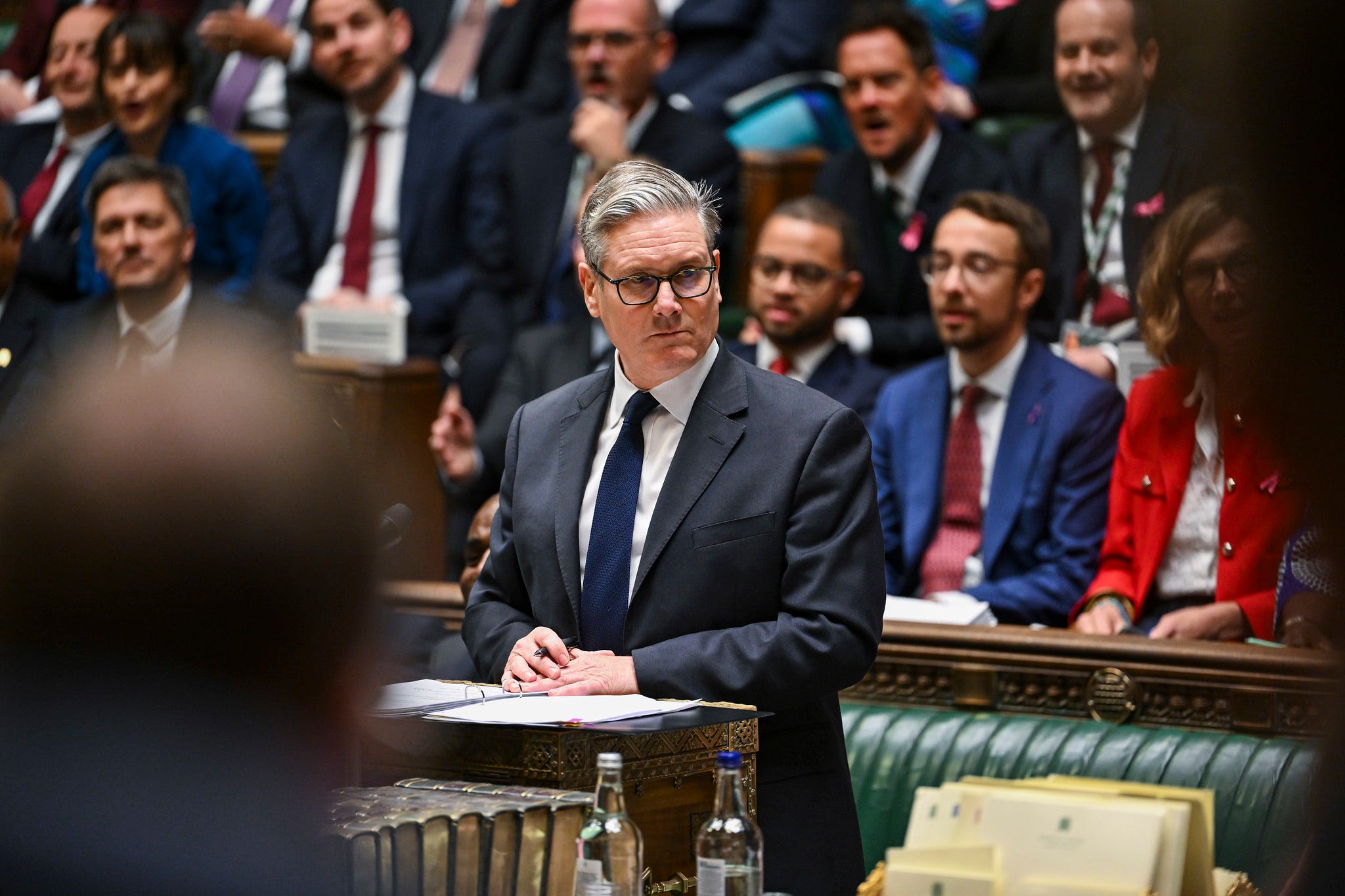
Around 8:30 this morning, Keir Starmer announced that he would resign as Britain’s Prime Minister. It was, to quote Ian Dunt, a “graceful and dignified end to a bitterly disappointing premiership.”
Starmer’s government entered office around this time in 2024 with a thundering majority, clenching 411 seats out of a possible 650, and reducing the Conservative Party (which had governed since 2010) to rump that was just one-third of its previous size.
It was a landslide victory, with Labour winning in areas that were always seen as beyond its reach, even during Tony Blair’s historic triumph in 1997, like those leafy rural constituencies in the Home Counties that always voted Blue.
Two years later, Labour is polling worse than Reform — a party that didn’t exist a few years ago, and is headed by a frog-faced millionaire crackpot who used to be a regular guest on Alex Jones’ Infowars, where he allegedly dabbled in a bit of antisemetic innuendo. Meanwhile, Starmer’s personal approval rating hovers somewhere between “Norovirus” and “standing on an upturned plug,” and just slightly below Cat Bin Woman.
How the fuck did this happen?
Here’s the bad news. Over the next few weeks, we’re going to see a lot of think pieces emerge, all making a case why one thing in particular — often the author’s personal pet issue — sank Starmer’s premiership.
I know this because this happens whenever there’s a big political shakeup. We saw it in 2016 when Hilary lost to Trump, and when the UK voted to leave the European Union, and again in 2024 when Harris lost her election bid.
I’m not going to do that in this piece, in part because Starmer’s precipitous decline in popularity is the product of a lot of different, disparate things. There wasn’t one massive singular fuck-up, like Liz Truss’s mini-budget, that soured the public on Starmer, but rather a lot of things — some of which were within the control of his government, and others which weren’t.
I am, however, going to focus on one particular issue. That of tech regulation.
When Labour entered office in 2024, there were a bunch of laws that the previous Tory government had passed, but had not yet entered force. The Online Safety Act was one such law.
The aims of the Online Safety Act were noble. Nobody wants to see kids get cyberbullied, or exposed to porn when they’re still developing their understanding of relationships and sexuality. The Internet can be a Wild West at times — a deeply unpleasant, hostile place — and it’s natural to want to protect children from the worst parts.
The problem is that the way the Online Safety Act went about achieving those aims was, by-and-large, deeply unpopular. I would also argue entirely counter-productive and ineffectual, but that’s an argument for another newsletter.
Suddenly, adults had to start verifying their ages to use websites that they’d always used — whether those be adult websites, or even just normal gaming or social media websites. I had to scan my face to be able to send and receive direct messages on BlueSky, for example.
This added friction where none previously existed. It also compelled people to hand over personal data — like their credit card information, or a scan of their passport or driver’s license — that they otherwise wouldn’t have done previously, and in scenarios where you would instinctively prefer to be anonymous.
Like those adult websites I mentioned earlier.
It didn’t help that kids quickly realized that these age verification systems could be bypassed, like by using a scan of a video game character, or by using a VPN or TOR, making that friction feel especially pointless.
Nor, for that matter, did it help when a bunch of these age verification services started getting hacked, resulting in the leak of thousands — and millions — of people’s personal information.
The Online Safety Act tasked Ofcom — Britain’s media and telecoms regulator — with enforcing many of its provisions. And when it tried to do so with websites like 4chan, which refused on the basis that it isn’t based in the UK and its activities are wholly consistent with US law.
Quoting Zoe Kleinman of the BBC:
The UK online safety regulator Ofcom has fined the US messaging platform 4Chan a total of £520,000 for failing to comply with various aspects of the Online Safety Act.
It includes £450,000 for failing to put in age checks to prevent children from seeing pornography on the platform.
However, a lawyer representing the company - which has previously said it won’t pay such fines - has responded to the demand with an AI-generated cartoon image of a hamster.
In a follow-up post on X, 4Chan’s lawyer Preston Byrne wrote: “In the only country in which 4chan operates, the United States, it is breaking no law and indeed its conduct is expressly protected by the First Amendment.”
The fines also include £50,000 for failing to assess the risk of illegal material being published and a further £20,000 for failing to set out how it protects users from criminal content.
4Chan has refused to pay all previous fines from Ofcom.
Ofcom — and by extension, Starmer’s government — looked impotent, and the friction that ordinary people had to tolerate, once again, looked pointless.
There’s also the optics.
After the Southport Riots in 2024 — which spread across the country after a deranged psychopath entered a children’s dance party and murdered three girls aged six, seven, and nine, and injured a further eleven people — law enforcement cracked down harshly on those who had participated in those riots, and those who had been seen to have incited the riots online.
Using laws that were passed long before Starmer had entered office, judges handed down stiff, punitive sentences to accused of being online cheerleaders — even to those who, outside of the context of mass civil unrest, would have been otherwise granted a degree of mercy.
Again, this isn’t outside of the realms of British norms. After the 2011 riots, which inspired country-wide looting, judges and magistrates handed down extremely punitive sentences to participants. One 23-year-old student who robbed a few bottles of water from a discount supermarket (valued at £3.50) ended up getting six months inside. Crimes that take place within the context of mass civil disorder tend to get punished more harshly than those that happened in normal conditions.
That context wasn’t apparent to everyone, however, and there was a widespread belief that many of the sentences given to those convicted of purely online activities — like Lucy Connolly, a married childminder who pled guilty on the expectation of receiving a suspended sentence, only to be imprisoned for a term of 31 months — were excessive.
A perception emerged — in part thanks to a steady drumbeat of messaging from right wing news outlets like GB News, and political personalities like Nigel Farage and JD Vance— that the Labour Party was inherently authoritarian, and Starmer himself was opposed to free speech. And that perception stuck, becoming a consensus, with Connoly becoming somewhat of a martyr.
Per Robyn Vinter of The Guardian:
You can’t have an opinion, you’ll get locked up like that Lucy Connolly,” says a shopper in Nuneaton town centre, giving an indication of how well known this childminder from Northampton is in some circles.
Connolly, the wife of a Tory councillor, unexpectedly became a cause célèbre for the far right last year when she was jailed for posting “set fire to all the fucking hotels full of the bastards” on social media, after falsely believing the Southport attack was carried out by a Muslim asylum seeker.
And now Connolly, who described herself as a “political prisoner” when she was released from jail last week, could be catapulted to international fame. On Wednesday Nigel Farage plans to raise her case with allies of Donald Trump on a visit to the US Congress, as “a symbol of Keir Starmer’s authoritarian, broken, two-tier Britain”.
The Online Safety Act all but confirmed that perception — even though it was, like I said, a law that was passed before the Labour Party entered government, and by a Conservative government with an effective supermajority, and thus could have passed it without any cross-party support.
And yet, the events that surrounded the Southport Riots allowed many to convince themselves that the provisions within the Online Safety Act — particularly age verification — were part of some conspiracy to restrict what people could do, see, and say on the Web.
Now, here’s the thing. Two things can be true at the same time.
I believe that the Labour Party is deeply authoritarian — and we can see that in things like its approach to drugs policy, both during this administration and in the last time that it was in office, its failure to repeal some of the anti-democratic changes to electoral law from the previous Tory government, and its failure to repeal the legislation passed by the previous government that restricted the right to protest.
Labour has always been willing to impose the state on the private lives of its citizens, and to curtail civil liberties, in part because it’s not a liberal party, but rather a social democratic party. This is not new to this government.
I also believe neither the Online Safety Act, nor the sentencing patterns following the Southport Riots, are particularly compelling evidence of Labour’s illiberalism. The first because it’s a law that wasn’t passed by the current Labour government, and the second because the types of sentences passed were pretty consistent with what we’ve seen during previous bouts of civil disorder.
I also believe that none of that shit matters when we’re talking about optics.
Rather than learn its lesson, the Labour Party is set to press forward with imposing age restrictions on social media websites, which will only harden the perception among many that Labour — and Starmer, and whoever replaces him, which will almost certainly be Andy Burnham — are opposed to free speech.
Again, I can fully get behind the idea of keeping kids away from social media. It’s a fucking hellhole, and as Starmer himself said, the tech companies have largely failed to take any meaningful measures that would protect kids.
Facebook itself conducted research that showed Instagram was ruinous for the mental health of teen girls — and rather than do something about it, it buried it and then gaslit everyone about what the research actually showed.
Facebook’s pivot to an algorithmic newsfeed for both Instagram and Facebook has pushed otherwise normal, rational people into self-perpetuating belief systems that hinge on elaborate conspiracies — which often results in the person alienating themselves from their family. It profited from the deepening polarization of our society.
I believe that social media is, broadly speaking, bad for kids — and arguably bad for adults, too — and I think that it’s perfectly reasonable to want to do something about it.
But I also know that any legislation that imposes an inconvenience on people — however minor — will be seen as a vast, aggressive overreach by a government that’s perceived to be actively hostile to basic civil liberties like freedom of speech.
I also understand that said perception is absolutely fatal in the polls, and is helping fuel the rise of Reform — a party of crackpots led by a millionaire grifter and serial liar.
You’re damned if you do, and damned if you don’t.
It doesn’t help that, rather than improve the law, the Labour Party is now considering imposing restrictions on VPNs.
Honestly, I feel extremely depressed about the whole thing, and I don’t have any answers to give you. We’re in a weird situation where there’s a bipartisan mistrust — if not active dislike — of the tech industry. And yet, nobody agrees on what to do about it, or even whether we should do anything about it.
Last year, Pew Research found that Mark Zuckerberg had a net unfavorability rating of 75. When you break that down across both major US political parties, you end up with a net unfavorability rating of 75 for Democrats and 60 for Republicans.
More recent data — also from Pew Research — show that Republicans and Democrats are equally concerned about AI, but disagree on whether any government is able to actually effectively regulate it. Pew didn’t only ask about Washington, where you’d expect a person’s partisan leaning to influence their answer — it also asked respondents whether China or the European Union was capable of establishing and enforcing standards.
And so, most likely, nothing is going to happen — or, if something does happen, the legislation will be tepid and ineffective, giving the perception of action while preserving the status quo.
It’s a bit like your house has caught fire. You want to call the fire brigade. Your roommate thinks that he can tackle it with a fire extinguisher and a bucket of water. And so, you do nothing — or, as a compromise, just spit impotently at the fire.
I just want to circle back to what I said at the start of this piece. I don’t believe that any singular issue is responsible for Starmer’s deep unpopularity, and why he lasted just two years in office, despite entering with a massive parliamentary majority.
I think, deep down, Brits are fucking miserable. We had the global financial crisis — which was followed by a prolonged and unnecessary brutal period of austerity, which killed economic growth, followed by Brexit (which did the same), followed by Covid. For the past fourteen years, we’ve seen our cities, our society, and our living standards crumble.
People want change. They’re impatient for their lives to stop being so shit.
The thing is, it’s far easier to wreck something than build something. A lot of the cuts to government spending and investment that happened in 2011, when the Conservative-Liberal Democrat coalition embarked upon its program of austerity, haven’t been reversed. Even if they were, it would take time and effort to rebuild the institutions and infrastructure that they wrecked.
We’re talking about the kind of change that takes a generation. And when Labour couldn’t deliver that overnight change that people wanted, it became so much easier to dislike them. Legislation that previously would have been a minor annoyance among the electorate became a massive, itching wound.
The irony is that the tech industry has such an outsized influence on our lives. Facebook, Twitter, and TikTok all determine what we see, who we interact with, and the terms on which those interactions happen. For better or worse, regulating these companies would have an impact on the lives of ordinary citizens.
It would be a real kind of change.
Just not a change that we can all believe in.
Putting anyone in jail for anything that appears next to their social media handles is naturally going to tank the popularity of whoever is currently in power. These laws need to be removed ASAP.
US based interests in tech, oil, animal ag, pharma, porn, media and arms have done a fantastic job in making us think the enemy is our government and legislation. They get us protesting ULEZ and age restrictions on the internet as part of an evil conspiracy of green policy and surveillance by authoritarians.
These interests, that we all buy into and support, get our leaders to do stuff that makes them unpopular so that we blame them and not their puppet masters. These industries continue to extract, exploit and profit without regulation and with impunity.