
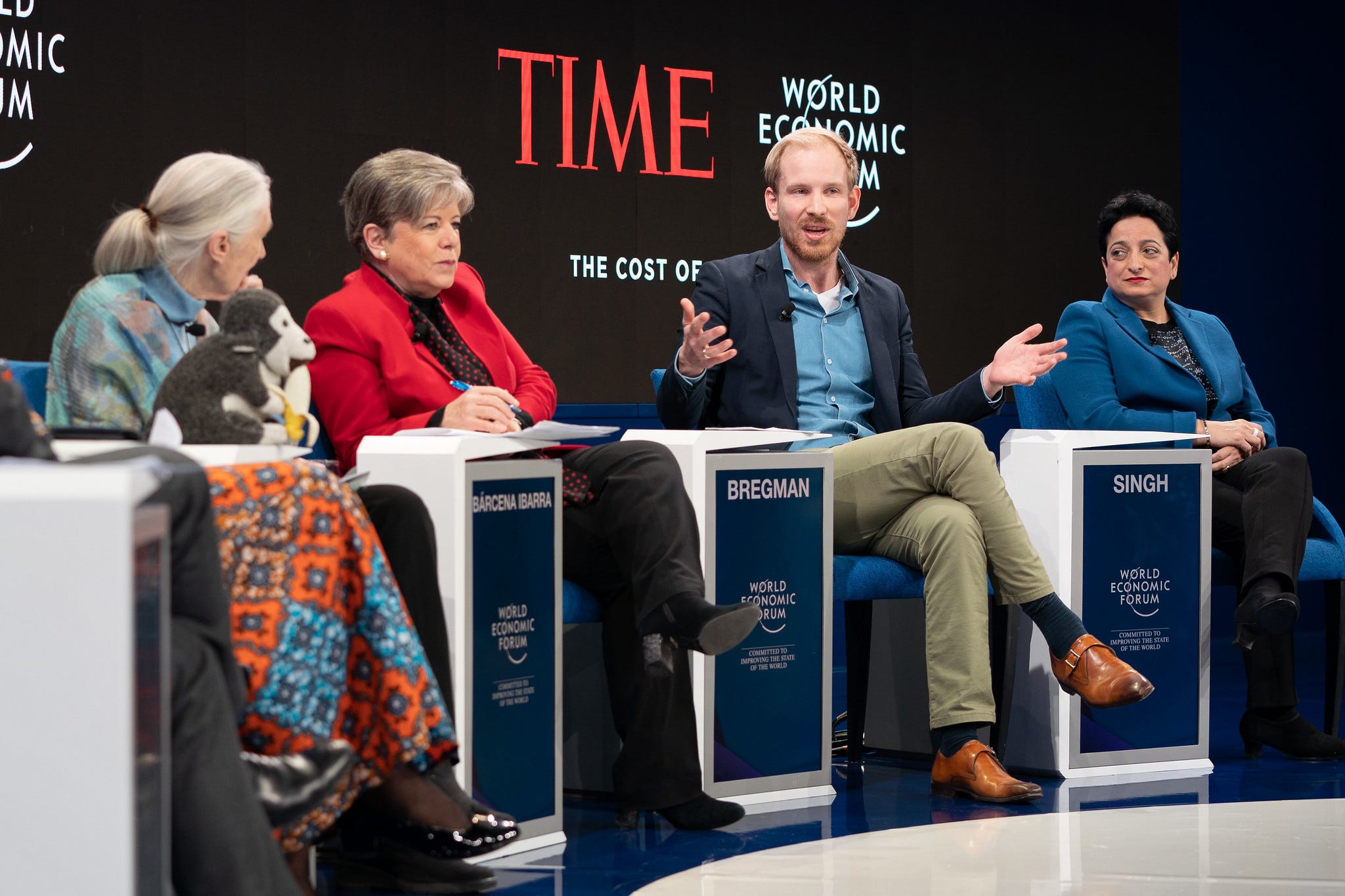
Rutger Bregman is a brilliant Dutch historian who has, better than perhaps anyone else, made the strongest case for why income inequality isn’t just a bad thing, but something that can be solved.
In a world filled with doomscrolling and an almost nihilistic air of defeatism, Bregman offers something that’s in short supply — namely, hope.
One more thing that I like about Bregman: He extracts great pleasure from aggravating the worst of the worst, whether they be tax-dodging billionaires, whom he called out directly on-stage at Davos, or swivel-eyed lunatic Tucker Carlson.
Which is why I was so disappointed to read his recent Substack newsletter, An Inconvenient Truth About AI, which was (and I don’t make this claim lightly) some of the worst writing about AI that I’ve ever had the misfortune to encounter.
That’s admittedly quite a hard bar to climb, and one that’ll only continue to get harder as Casey Newton and Kevin Roose continue to publish.
I’m not kidding. I’ve read AI 2027 and Citrini Research’s 2028 Global Intelligence Crisis. And those two fucking sucked. This was (somehow) much, much worse.
Sidenote: The latter will be the subject of a future newsletter. I’ve been working on it for a few weeks now, and it’s taking a while, but you’ll enjoy it.
While you can (and should) read Bregman’s newsletter, I’m going to summarize Bregman’s core argument.
Climate denial is a partisan issue. Those on the left accept the scientific consensus on global warming far more readily than those on the political right, who are often either ambivalent to the risks of anthropogenic climate change, or believe it to be the subject of a massive, shady conspiracy.
Similarly, AI denialism — which is not a thing — is similarly partisan. Bregman says that those on the political left refuse to accept as gospel that generative AI can do the things that its progenitors claim, and that it’ll result in massive destruction to jobs and working conditions.
The refusal of the left to accept this alleged reality means that we’re, therefore, less able to mitigate the impact of AI — or, better yet, use AI to create a utopian society.
Allow me to quote from Bregman’s piece:
Within two years, Al Gore has won an Oscar and a Nobel Peace Prize. For one brief moment, it feels as though the world might finally listen.
But we all know what happened next. The climate deniers mobilized. They brought a snowball onto the Senate floor and asked, where’s your global warming now? They said things that were technically true (like CO2 is good for plant growth) and completely misleading. And above all, they moved the goalposts.
First it was: the climate isn’t warming. Then it became: fine, it’s warming, but not because of us. Then it was: okay, it’s us, but it won’t be that bad. Then it became: alright, it’s pretty bad, but… it’s China’s fault and we can’t afford to fix it.
The whole time, Al Gore’s red line kept climbing.
I was 18 years old in 2006, and I was furious. How could any serious person look at this evidence and refuse to see it? Climate denial, I thought, was a disease of the right.
And you know what? I was wrong. Not about the right, but about who else is capable of denial. Because we, the liberals, the left, the journalists, the academics, the 97% ‘In this House we Believe that Science is Real’ crowd, we are now doing to the threat of artificial intelligence exactly what the right did to the threat of climate change.
The deniers are us.
The problem with casting mistrust or dislike of generative AI in partisan terms is, quite simply, it doesn’t work.
A Partisan Square In A Bipartisan Circle
I can understand the instinct to say that the anti-AI crowd are aligned with the political left, in part because some of the loudest, most vocal critics of generative AI self-identify with left-wing or progressive causes.
I’d include myself in that list, by the way. My politics are broadly left-of-center — although I’m very much a floating voter, and I’ve voted for candidates from several left-wing and progressive parties since I turned 18.
The problem is that my criticisms — and those levied against AI by others, like Ed Zitron and Gary Marcus — exist (and are coherent) without the inclusion of any kind of partisan politics.
You could probably group critics of AI into three distinct categories:
Those whose work focuses primarily on the technical limitations of large language models. These would include the likes of Gary Marcus, Timnit Gebru, and Molly White.
Those who object to generative AI on an aesthetic and functional level. I suppose my work would probably fall under that category.
Those who are critical of the underlying economics of generative AI. That’s Ed Zitron and JustDario.
The question therefore becomes, could you make the same arguments while also being aligned with the political right? Obviously, yes.
As an aside: Someone suggested on Twitter that Bregman read Zitron, and he responded by replying with a hit piece (which I won’t link to) written by an imbecile.
I’ll simply note that when that piece came out, I wrote 4,000 words in a matter of two hours explaining, point-by-point, where the author had misrepresented Ed’s work or straight-up lied.
That’s something I can do because I’ve been Zitron’s editor for the past several years, and I’m more acquainted with his work than anyone else.
I decided not to post it in the end because:
A.) I was a bit rude. The words “dumbfuck,” “moron,” and “dipshit” appeared throughout the piece. An earlier draft may have described her as being on the same intellectual level as people who clap when a plane lands.
B.) Ed’s a big boy, and as much as I pride myself in my loyalty to my friends (I’m Scouse! It’s in my blood!), it’s probably not a good look if I just charged forward and fought his battles for him.
C.) Literally anyone who has ever read Ed’s work would instantly recognize how flagrantly the author lied, and there’s something to be said about not getting into online scraps with liars, crackpots, and otherwise bad actors.
Vagueposting about them, however, is perfectly fine.
Let’s stick with the economic arguments for a minute.
Let’s imagine that, instead of Ed Zitron, someone like Bill Ackman claimed that the demand for AI services from enterprises is nowhere near close enough to justify the capital expenditures of hyperscalers, and that the flow of money within the AI industry is worryingly circular.
Ackman, I note, is not exactly on the political left.
Would that raise any eyebrows? No! That’s basically what short-sellers do! They research shit, open a short position, and then publish their reports.
Similarly, could someone whose politics skew towards the right make a case that LLMs are, essentially, guessing machines? Or that their outputs are aesthetically unpleasant? Or could they even just hold those opinions without necessarily voicing them?
Sure they could. And I’m sure that many have.
Why Bregman Took A Partisan View — A Theory
If I had to guess, I’d imagine that Bregman drew his conclusion that dislike for AI is inherently partisan because of the nature of online spaces.
Sidenote: To be clear, I have no idea about the specific political leanings of many of the AI critics mentioned earlier. I have no idea of whether, say, Gary Marcus votes Blue no matter who, or whether he has a Ronald Regan poster hanging up in his bedroom.
Nor, for that matter, is his political persuasion even remotely pertinent to anything he’s ever written about.
On one hand, you have X — née Twitter — which is now part of SpaceX’s artificial intelligence business unit, is tightly integrated with SpaceX’s LLM, Grok, and whose user base is decidedly right-wing.
Then you have bastions of left-wing thought like BlueSky, where generative AI is about as popular as smallpox. These two platforms are, as far as their political leanings go, diametrically opposed, and it’s not entirely unreasonable to therefore conclude that enthusiasm for AI similarly splits along bipartisan lines.
The problem, however, is fourfold:
First, BlueSky and Twitter are hardly representative of the public at large, with the former having (at the time of writing) 44.7 million users, and the latter continuing to shed users.
In fact, I’d argue that social media is a fairly poor barometer for public sentiment.
The transformation of sites like Facebook and Twitter from genuine social networks into content recommendation engines has effectively turned the public from posters to lurkers.
Secondly, there’s no very little evidence from polling data that one’s enthusiasm for (or mistrust of) AI is influenced by one’s politics.
The only real partisan divergence is whether one believes that government regulation is required. And that’s hardly surprising, considering that Republicans have always been skeptical of (if not entirely hostile to) business regulation.
Third, if there was a partisan split, why are strongly Republican areas like Florida’s Pasco County considering moratoriums on data center development?
And why have some areas, like Daviess County in Kentucky, which voted for Trump by a 2:1 margin, actually passed moratoriums on new data center construction?
And why are we seeing the same pushback in staunchly Democratic areas, like New York and Seattle?
Finally, if enthusiasm for AI is inherently partisan, how do you explain the phenomenon of left-leaning politicians and parties (particularly those in Europe) embracing generative AI?
Last year, Venezuelan President Nicolas Maduro wanted to create a “sovereign AI”.
Maduro, incidentally, was quite partial to a bit of AI slop.
Similarly, since entering government, the UK’s Labour Party has signed memorandums of understanding with both OpenAI and Anthropic.
Bregman’s partisan argument just doesn’t work, and it’s so strange that he even made it.
Bregman Bought The Hype
So, we’ve addressed the framing. Let’s talk about the substance.
Bregman goes on to make two claims:
That generative AI has meaningfully improved since the early days of ChatGPT, to the extent where it can now match human knowledge workers in specific arenas.
That the explosion in AI-related Capex spending proves that generative AI is here for the long-haul.
Let’s address the first one.
Bregman makes an argument that generative AI’s capabilities have advanced so far, so quickly, that earlier criticisms of LLMs (namely that they don’t “know” anything in the meaningful sense of the word, and they’re just guessing machines) are effectively moot.
He says:
In March 2023, The New York Times published an op-ed by Noam Chomsky: one of the most prominent intellectuals alive and a hero of my political tradition. The piece was called The False Promise of ChatGPT. Chomsky argued that AI is incapable of real thought and that treating them as intelligent was a basic mistake. He called them a ‘lumbering statistical engine for pattern matching’.
This was the consensus of a lot of serious people. The New Yorker ran a long essay arguing that ChatGPT was a blurry JPEG of the web, a lossy compressor that memorized the internet badly and hallucinated the rest. In 2021, the linguist Emily Bender and the computer scientist Timnit Gebru had given this whole skeptical movement its slogan: these machines, they wrote, are stochastic parrots. They just imitate.
Chomsky, Bender, Gebru are smart people. And yes, some of what they have warned about has come true. The web is drowning in machine-generated slop, the training data is biased and the energy bill is pretty staggering. But their central conviction, that this whole Silicon Valley AI-project would hit a wall any minute now, that conviction has completely collapsed.
To be clear, Chomsky isn’t wrong. LLMs are, quite literally, a “statistical engine for pattern matching.” That’s literally what the tech is. They don’t know anything. They use a mathematical model to make guesses about which token should follow the one that preceded it.
That’s why they hallucinate, and why hallucinations are — as OpenAI admitted — an unsolvable problem.
Bregman goes on to cite a few examples of LLMs accomplishing things that would normally take a human a lifetime to achieve, like passing medical licensing exams and winning gold medals at the International Mathematical Olympiad.
The problem with the first example is that passing a medical licensing exam, just like passing the bar, is something that can be accomplished by simply knowing the answers — or, in the case of an LLM, being trained on the answers.
Bregman also mentions AI outperforming doctors in a diagnostic head-to-head competition, linking to a 2025 piece from Time which claimed that “[Microsoft’s] AI-based medical program, the Microsoft AI Diagnostic Orchestrator (MAI-DxO), correctly diagnosed 85% of cases described in the New England Journal of Medicine,” outperforming 21 human doctors which tackled the same challenges.
The diagnostic accuracy of the human doctors was a measly 19.9%. Oh, and the tests they ordered were, on average, more expensive than those that the AI picked.
Impressive, right? Game over for human doctors, eh? Well, if you actually read the paper, not really.
You see, the scenario that Microsoft created was totally artificial, with no human patient to examine. An actual doctor asks questions, uses their senses of sight and touch, and general observations about the patient to come to a diagnosis. This scenario essentially deprived the human doctors of that ability.
Oh, another thing: Microsoft gave the human doctors 56 test patients to diagnose, whereas the AI was given 304 cases.
Another reason why this scenario is bullshit is that the cohort of 21 doctors used to benchmark the AI system were either primary care physicians or hospital generalists. This is something that Microsoft Research noted in the section titled “Explaining Superhuman Performance.”
Today, frontier AI language models are challenging this traditional structure. These advanced systems show remarkable versatility, demonstrating both broad and deep medical understanding, and the polymathic ability to reason across specialties. In effect, they combine the generalist’s range with specialists’ depth. As a result, they significantly outperform individual physicians on complex diagnostic problems, such as those featured in the NEJM CPC cases. Our findings highlight this impressive capability. Expecting any single doctor to master the full range of such cases is unrealistic.
And:
This raises an intriguing question: When evaluating frontier AI systems, should we evaluate frontier AI systems by comparing them to individual physicians, or to entire hospital-like teams of generalists and specialists? The answer to this question will help both define and shape the future role of AI in healthcare.
Are you fucking kidding me?
Rutger, please. I’m begging you. Tell me you don’t find me this shit persuasive.
Yeah, I’m not surprised that non-specialist physicians, when asked to accurately diagnose cases that usually require specialist input, fared poorly. That’s why we have specialists.
Oh, another thing: the doctors were prevented from using external resources to help them make diagnoses. Again, quoting the paper:
Physicians were explicitly instructed not to use external resources, including search engines (e.g., Google, Bing), language models (e.g., ChatGPT, Gemini, Copilot, etc), or other online sources of medical information. Although limiting the use of search engines may not accurately reflect physicians’ real world clinical practice, the original NEJM cases are accessible online, and we sought to prevent participants from readily obtaining correct answers through external searches. Additionally, certain search engines offer AI-generated summaries, potentially providing diagnostic hints. By restricting physicians’ access to language models, we aimed specifically to assess their intrinsic diagnostic capabilities, rather than indirectly evaluating the performance of available generative artificial intelligence tools.
Again, I ask: Are you fucking kidding me, Rutger?
Speaking from personal experience, I’ve had a bunch of doctor’s appointments where the physician had to look something up — like whether a medication might conflict with one I’m already taking. I would be concerned if they didn’t.
How the fuck do you test a physician’s “intrinsic diagnostic capabilities” if you prevent them from actually finding and confirming information that they need to actually make a diagnosis.
This is silly. Microsoft contrived the dumbest, most lop-sided test ever, and used it as evidence that AI can outperform human physicians, and then Rutger decided to use it as fodder in an article where he argued that opposition to generative AI is simple leftist myopia and denialism.
It’s moronic.
Rutger gave a few other examples, and honestly, I could quite easily dedicate thousands of words to explaining why those tests or examples are flawed, and why they aren’t indicative of generative AI’s inevitability.
He gave the example of how, inside “leading AI labs, more than 90% of the code is currently written by AI,” but never followed up with the question of whether any of that code is actually good.
As I explained in my most recent newsletter, it isn’t.
“A bunch of former McKinsey dipshits can’t be wrong, right?”
Rutger’s next argument is that hyperscalers are spending hundreds of billions on AI-related capex each year, and therefore, there’s something tangible, or real, or worthwhile in the AI bubble.
To be clear: this is the largest capital build-out in the recorded history of our species. It’s larger than the interstate highway system. Larger than the International Space Station. Larger than the Moon Landing and the Manhattan Project combined, and it is not even close.
And:
Mark Zuckerberg’s Meta is currently building a single data center in Louisiana that, when finished, will cover nearly four times the size of Central Park. Amazon is spending more on data centers in one year than the entire annual defense budget of Germany. Microsoft, Google, Meta and Amazon will spend three times as much on AI infrastructure in 2026 than the entire Marshall Plan that rebuilt Europe after the Second World War.
He then goes on to ask whether it’s all a bubble, mentioning the “ammunition” that skeptics have — like the fact that most AI pilots have no measurable return on investment, or how companies like Klarna and McDonald’s pivoted to AI, and then pivoted right back when it turned out the tech was completely dogshit.
But that, he insists, proves nothing.
His first example — the fast growth of ChatGPT compared to Instagram.
It took Instagram 2.5 years to reach 100 million users. At the time, that was the fastest growth story ever recorded. For comparison: ChatGPT hit that milestone in 2 months. Fifteen times faster.
Rutger, please, I’m fucking begging you to read anything vaguely critical of the AI industry. ANYTHING. A few points:
First, OpenAI’s ability to convert free ChatGPT users to paid users is, quite frankly, abysmal. According to The Information, its conversion rate sits around 6%. Not good!
Especially not good when you consider that generative AI is:
Very fucking expensive.
Wait, no. That’s all I need.
Every single one of those free users is an anvil around the neck of OpenAI, draining the company of money, and contributing to its margins of negative 122%.
Oh, and it’s not even like OpenAI’s profitable with its paid subscriptions either, given that it (as with Anthropic) allows its subscribers to burn way more tokens than they actually pay for.
It’s for this reason why OpenAI and Anthropic (and others) are pushing towards token-based billing.
He then goes on to mention Anthropic’s fast-growing ARR, which jumped from $1bn in January 2025 to $5bn in May 2026. Again, this is not a convincing argument:
ARR is a miserable, dishonest, misleading metric. Essentially, a company takes a one-month period and multiplies it by twelve.
The first problem: Companies can cherry-pick which periods to use.
Anthropic doesn’t report its financials like a publicly-traded company does. They aren’t forced to issue stark, candid numbers like those you’d get from an SEC filing. And it isn’t obliged to publish them on a regular cadence (say, quarterly).
And so, if it has a particularly good month — say, some dipshit forgot to turn off spending caps and ended up burning half a billion dollars worth of tokens — it can self-report those numbers.
And if it has a bad month, it can remain shtum.
The second problem: Anthropic’s business is vulnerable to spending outliers that give it the opportunity to present misleading numbers.
That $500m token binge example I gave earlier wasn’t hypothetical, by the way.
Finally, the previous numbers are reflective of a time when customer spending was largely subsidized. Anthropic is transitioning to a token-based billing model now, and a lot of major users — like Uber and Brex — are starting to pull back on their spending, in part because generative AI is (as I mentioned earlier) very fucking expensive.
There’s also the fact that Anthropic (in particular) is very fucking dodgy when it comes to its numbers, but I’ll leave that to one side for now.
Rutger doesn’t mention, at any point, whether the AI industry is profitable, or has a path to profitability, or whether it’s sustainable without continuous inflows of capital from hyperscalers, venture capital firms, and sovereign wealth funds.
And that’s because it isn’t.
You can argue that generative AI is useful in some areas, or that you personally have found it useful, but it’s a lot harder to make an economic case for the AI bubble not, in fact, being a bubble.
The reason why it’s harder to make the non-bubble case is because all the evidence points in the other direction.
Did you read SpaceX’s S-1? It made more money in 2025 from selling ads than from Grok — and (inflation adjusted) it made less money from ads than in Twitter’s last quarter as a publicly-traded company.
That is fucking pathetic.
If LLMs are the future, why are only six percent of ChatGPT users actually paying for a subscription? Outside of massive capex investments from hyperscalers and neoclouds, where’s the money? Why did Anthropic only make $5bn between its launch and March of this year? Surely if there was such intense demand for LLMs, it would have made more, right?
These are questions that, I believe, anyone regardless of their political affiliation — Democrat or Republican, Labour or Conservative — could answer without feeling particularly conflicted.
And that’s because — to go back to my earlier point — they aren’t partisan. They’re numbers. They’re facts. They’re observations about reality.
A Really Inconvenient Truth
I’m going to try and be a bit empathetic here. I genuinely believe the following:
That Rutger Bregman sincerely fears that generative AI could destroy middle-class prosperity, while simultaneously benefiting the wealthiest of tech oligarchs.
He’s deeply alarmed that those from his own political tribe — the left — don’t share his fears, because they aren’t convinced that generative AI is capable of doing what its cheerleaders claim it can do.
That’s fair enough.
The problem is that Bregman presumes that the left is unconcerned about the capabilities of AI for ideological reasons, rather than the fact that they’ve simply reached different conclusions than him.
Bregman wrote about how he used an LLM to make software, despite having “personally never written a line of code in [his] life.” And I imagine that whole process felt exciting — empowering, even.
I don’t want to take that away from him. But at the same time, Bregman avoids asking the questions:
Is the code itself good — as in, would it ever pass muster in a business environment, or is it of the quality of a hobbyist app, or a prototype?
If he had to pay the per-token costs to actually build it — including the prompts where the LLM hallucinated, or failed — would he be just as impressed?
Microsoft just started charging Github Copilot users the actual cost of compute, and it’s astonishing to see how quickly the sentiment has shifted from “wow, this is really useful,” to “god, this is fucking expensive.”
Bregman, like a lot of people, has been conned. It’s easy to conclude that LLMs are useful — if not inevitable — when you aren’t faced with the real cost. It’s easy to believe the audacious claims of AI companies like Microsoft when you don’t actually read what their research papers say.
The AI industry has used fear — particularly a fear of apocalyptic levels of AI-driven job destruction — as a marketing tool.
It’s shockingly effective. Smart people — people I admire, like Rutger, who do have a conscience, and who do care about their fellow person — fall for it.
The antidote is to ask questions. To probe. To interrogate. To listen not just to the voices of boosters and those with a vested interest in the AI bubble continuing to rumble on, but also to the critics and the skeptics.
People like Marcus, Zitron, and the many, many others who are doing an incredible job of calling out the AI industry out on its bullshit.
Bravery doesn’t have to be partisan.
fantastic article, one small point to support your anger - instagram launched in 2009. if still managed to gain one million users in three months. this is only two years after the launch of the first iphone. it is incredible how picky choosy the AI cucks will be to justify their stupid product. like every data point is skewed intentionally by some of the smartest people. what a shame. thank you for this article.
Thank you for this, I was really disappointed with Bregman's article - it seemed as though he'd drunk the cool aid. I think that it's wedded to his increasing focus on productivity as a measure of success, as opposed to building meaning. He seemed to dismiss the huge environmental concerns over the whole AI infrastructure development too. Together, they suggest a world view rooted in the assumptions of capitalism as a 'natural' order, which serves to disempower both the real communities and the 'communities' of users who are already resisting AI.